Start with the load and duty cycle
Generators in Baton Rouge are often asked to support mixed loads: ventilation for confined-space work, pumps for dewatering, and task lighting. The surge profile, the longest expected continuous draw, and any motor starts dictate the generator class. Identify whether power will feed sensitive electronics or only tools and lighting; that affects whether tighter voltage regulation is needed.
- Note total running watts plus the highest starting load.
- Clarify if the unit will parallel with another or stand alone.
- Plan for fuel storage and refueling windows around shift changes.
Heat, humidity, and runtime
High heat and humidity increase thermal stress and can shorten service intervals. Longer nighttime shifts during outages may require extended run tanks or scheduled downtime. Where units sit near steam or washdown areas, enclosure rating and corrosion-resistant fittings matter.
Ground conditions and access routes
Saturated soils and leveled fill around industrial sites mean the staging pad matters as much as the kilowatts. Before committing to a size:
- Can a towable unit reach the pad without ruts or standing water?
- Will the machine sit below the task area next to cable paths, or up on a berm away from traffic?
- Are cable runs crossing vehicle routes that also carry lifts like /telehandler-rental/ or /forklift-rental/?
Light tower selection in port and plant settings
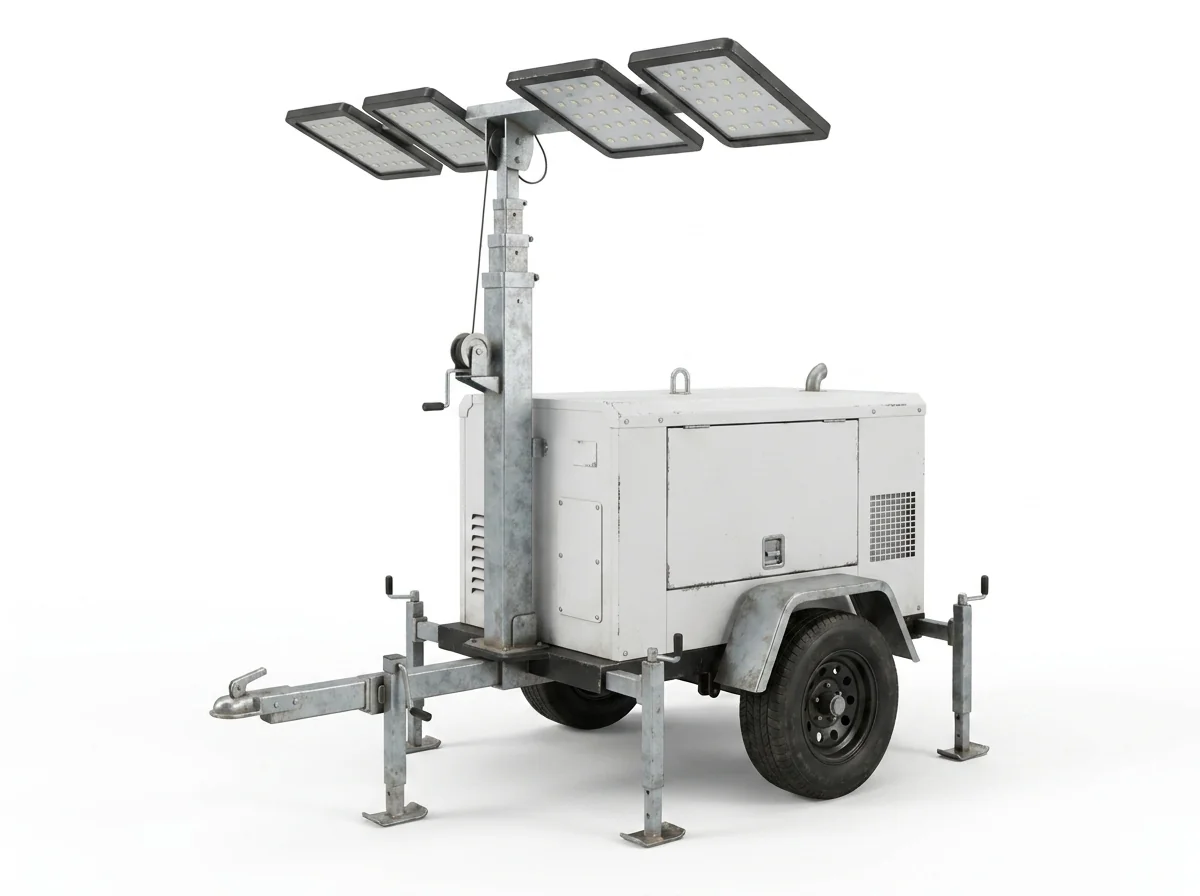
Tall mast lighting helps along dock edges, laydown yards, and pipe racks. Compare mast height to nearby obstructions and consider backlight and glare toward traffic lanes. In windy, open yards, stabilizer footprint and surface bearing pressure guide the tower class. In humid air, lens clarity and sealed connectors keep output consistent.
- Mounting height vs. spill light onto neighboring work.
- Fuel type consistency with site generators.
- Reflective surfaces near process units can amplify glare.
Coordinating with aerial work
If lifts will work under lights at night, confirm swing clearance so booms or /rough-terrain-scissor-lift-rental/ units don’t intersect guy lines or power cables. For interior tasks in high-bay warehouses, quiet, low-emission options reduce exhaust and heat around /electric-scissor-lift-rental/ zones.
When to step up or down a class
- Step up: long cable runs, frequent motor starts, or shared loads between multiple trades.
- Step down: short, localized lighting or intermittent use in a small bay where a compact set is easier to position.
Actual site conditions, the selected unit’s instructions, and facility procedures govern setup and operation.